

Your website is often the first — and sometimes only — impression a potential customer forms of your business before deciding whether to trust you. A website that looked fine five years ago can quietly become a liability without anyone at the company noticing, simply because expectations, devices, and search technology keep moving forward. Here are five clear signs it’s time to rebuild rather than patch.
1. It Doesn’t Look or Work Right on Mobile
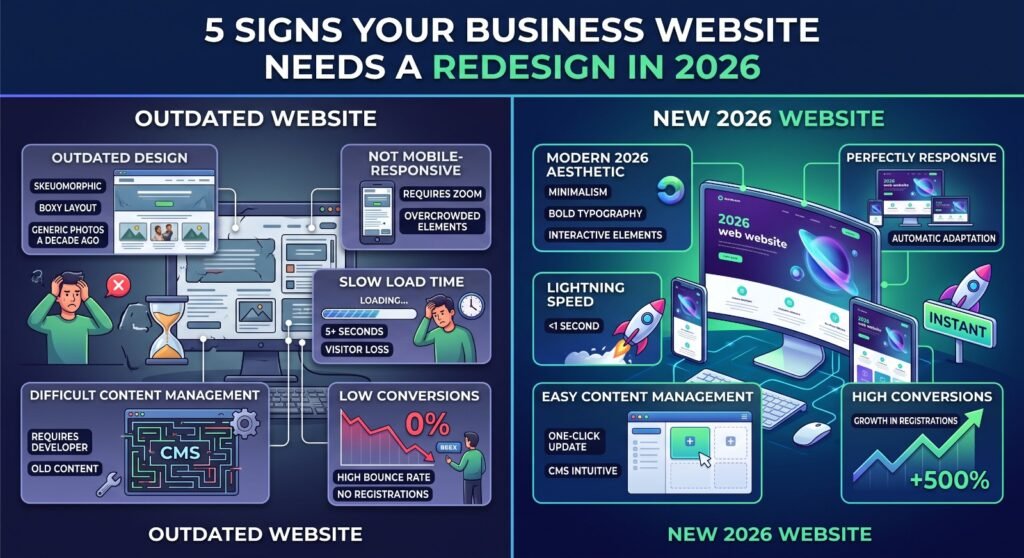
If your site was designed primarily for desktop and mobile feels like an afterthought — tiny text, buttons that are hard to tap, horizontal scrolling — you’re likely losing the majority of your visitors before they even engage, since most web traffic today happens on mobile devices. A modern, mobile-first design isn’t optional anymore; it’s the baseline.
2. It’s Slow to Load
If pages take more than a couple of seconds to load, or feel sluggish when someone clicks a button, visitors notice immediately — and many simply leave. Slow websites also perform worse in Google’s rankings because page experience is a measurable ranking signal today, not just a nice-to-have. (For more detail, see our article on Core Web Vitals.)
3. You Can’t Update It Yourself
If every small text change or new page requires calling a developer and waiting days, your website is holding your marketing back. A well-built modern site should let your team update copy, add pages, or publish a blog post without needing outside help for routine changes.
4. It Doesn’t Reflect What Your Business Actually Does Today
Businesses evolve — new services, new positioning, new team, new pricing model — but many websites are frozen in whatever state they were built in years ago. If your site describes services you no longer offer, uses outdated branding, or simply doesn’t represent the business you’ve become, it’s actively working against you rather than for you.
5. It’s Not Bringing In Leads
A website that gets visitors but rarely converts them into inquiries, calls, or purchases usually has one (or several) of these problems: unclear messaging, a confusing layout, weak calls to action, or a lack of trust signals like reviews, case studies, or clear contact information. If you can’t remember the last lead that came directly from your website, that’s a strong signal something structural needs to change.
What to Prioritize When You Redesign
- Clarity first. A visitor should understand what you do, who it’s for, and what to do next within seconds of landing on your homepage.
- Speed and technical health. Build the new site with performance and Core Web Vitals in mind from day one, not as an afterthought.
- SEO and AEO foundations. A redesign is the ideal moment to fix structural SEO issues and set up your content to perform well in both classic search and AI answer engines.
- Easy content management. Choose a platform (like WordPress) that lets your team make everyday updates independently.
- Clear conversion paths. Make it obvious and easy for a visitor to contact you, request a quote, or make a purchase.
FAQ
How do I know if I need a full redesign or just updates?
If the core structure, navigation, and technical foundation are sound and only the content or visuals feel outdated, targeted updates may be enough. If the site is slow, hard to update, or fundamentally doesn’t reflect your business anymore, a redesign is usually the better investment.
How long does a website redesign typically take?
It depends on scope, but most small-to-medium business redesigns take a few weeks from planning to launch, assuming timely feedback and content from the client.
Will a redesign hurt my existing search rankings?
Not if it’s planned properly. A well-executed redesign — with proper redirects, preserved URL structure where possible, and attention to technical SEO — can maintain or even improve your existing rankings.
Thinking About a Redesign?
Makis Web builds websites that are fast, easy to manage, and designed to bring in business — not just look good. Get in touch for a free assessment of your current site.